
In the vast power network, current flows like a rushing river, continuously providing power for our lives and work. However, this powerful energy must be strictly controlled and protected during transmission to prevent it from getting out of control or leaking, which can cause damage to personnel and equipment. In this process, insulators, as indispensable key components in the power system, play a crucial role. This article will delve into the role of insulators, revealing their invisible power in electrical safety.
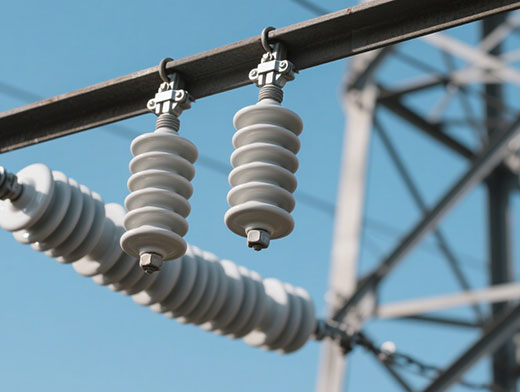
Insulators are devices used to isolate the conductive parts of electrical equipment from the ground or other conductive parts, keeping them electrically insulated. They are usually made of insulating materials, such as ceramics, glass, composite materials, etc., and can withstand voltage, mechanical stress, and harsh environments. There are many types of insulators, which can be divided into suspension insulators, pin-type insulators, pillar insulators, and other types according to their use and installation location.
There are many types of insulators. From the material perspective, there are silicone rubber insulators, glass insulators, ceramic insulators, resin insulators, etc.; from the functionality perspective, there are suspension insulators, pin-type insulators, pillar insulators, cross-arm insulators, anti-wind insulators, etc. Below is a simple introduction to some common types:
These insulators play a crucial role in high-voltage overhead transmission and distribution lines. They not only provide insulation but also fix the wires. Typically, multiple insulator components are assembled into a string to meet different voltage levels. Especially noteworthy is that in high-voltage or ultra-high-voltage transmission lines, suspension ground wire ceramic insulators are used to hang lightning conductors. These insulators have different glaze colors, such as white, brown, milky white, and blue, providing strong security for the safe operation of the lines.
Disc suspension glass insulators, based on their characteristics, can be divided into ordinary type, standard type, and pollution-resistant type. Additionally, there are special designs such as spherical type and aerodynamic type, which also play an indispensable role in high-voltage transmission and distribution lines.
Rod suspension composite insulators are produced using advanced integral injection molding technology. Their umbrella cover design is aesthetically pleasing, with fewer interfaces, and the bonding between the core rod and the sheath is tight and seamless, ensuring excellent internal insulation performance and effectively avoiding interface breakdown risks. Furthermore, they have a compact structure, small size, lightweight, and good elasticity, requiring no regular cleaning. These features greatly facilitate transportation and installation, significantly reduce maintenance workload and costs, and provide superior conditions for accident repair and implementation of compact lines.
Rod suspension insulators, as a new type of insulator in recent years, have metallic end fittings at both ends, and the middle adopts a high-strength mutual design.
This insulator has several significant advantages:
① Its non-puncturable structural characteristics effectively avoid the problem of steel cap explosions caused by mud creep or thermal faults in basin insulators;
② The long rod design reduces the number of fittings, simplifying the structure.
③ Excellent electrical performance, particularly the increased creepage distance, significantly improves its pollution resistance;
④ Greatly reduces the level of radio interference;
⑤ There are no issues with zero-value and low-value insulators, ensuring safety and reliability in use.
The most basic function of insulators is to provide electrical insulation. In the power system, sufficient electrical isolation must be maintained between various electrical devices and between devices and the ground to prevent current leakage and short-circuit accidents. Insulators, through their high resistivity and low conductivity characteristics, effectively block the electrical connection between electrical devices, ensuring safe and stable power transmission.
In addition to electrical insulation, insulators also provide important mechanical support. In high-voltage transmission lines, wires need to span across complex terrains such as mountains and rivers, which requires insulators to provide stable support points. Through their robust structure and material properties, insulators can withstand the weight of the wires, wind forces, and temperature changes, ensuring the normal operation and stability of power transmission.
Insulators also have certain environmental protection functions. In harsh climatic conditions, such as lightning, pollution, ice, and snow, insulators can effectively resist these external factors, protecting electrical facilities from damage. Especially for composite insulators made of new materials, their weather resistance and anti-pollution capabilities are stronger, enabling long-term stable operation in harsher environments.
The excellent performance of insulators helps to improve the reliability of the entire power system. When a part of the power system fails, insulators can quickly isolate the fault point, preventing the fault from expanding and affecting the normal operation of other equipment. This not only reduces the duration and range of power outages but also improves the overall operational efficiency and service quality of the power system.
With the rapid development of the power industry and technological advances, the performance of insulators is also continuously improving and refining. The continuous emergence of new materials, new processes, and new technologies has injected new vitality into the development of insulators. For instance, composite insulators, with their lightweight, high strength, and good pollution resistance, are gradually replacing traditional ceramic insulators. Smart insulators, by integrating sensors and monitoring technology, achieve real-time monitoring and early warning of insulator status, further enhancing the safety and reliability of the power system.
As indispensable key components in the power system, insulators play a crucial role in ensuring the safe and stable transmission of electricity. From electrical insulation to mechanical support, environmental protection, and improving system reliability, insulators show their unique advantages and value. With continuous innovation and development of technology, we have reason to believe that insulators will play an even more important role in the future power system, contributing to building a safer, more reliable, and greener power network. Histe continues to lead the way as a forward-thinking insulator company by integrating advanced materials and innovative designs to enhance the safety and efficiency of global power distribution networks.